What it’s for
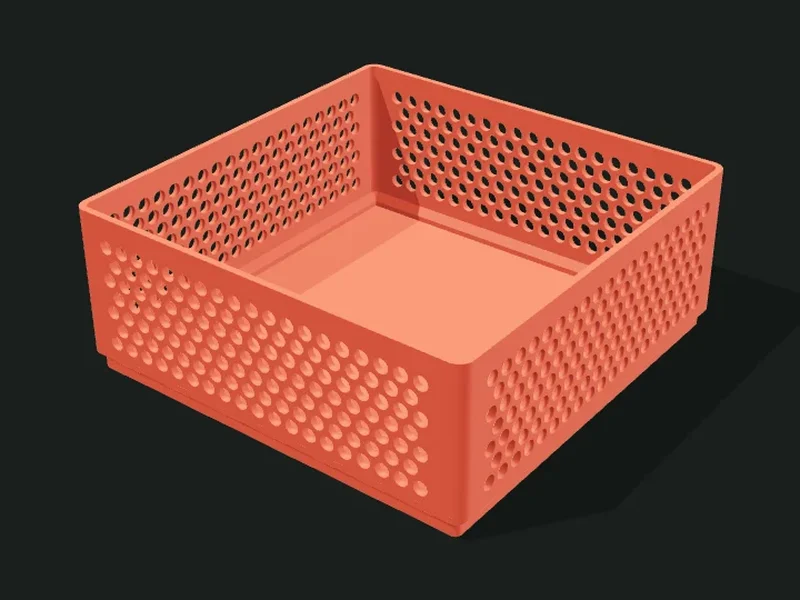
A basket with perforated walls (holes in a honeycomb, circle, teardrop, diamond or slot pattern) that can be stacked: each basket’s foot fits into the opening of the one below. Optionally it has a slanted opening at the front, like a produce crate, to take things out without unstacking.
Ideas
- Stackable crates for vegetables, potatoes and onions (the perforation lets them breathe).
- Bathroom baskets for wipes, brushes or products.
- Shelf or closet organizers that look light.
- Perforated tray for drying small dishes or washed fruit.
Step by step
- Choose a preset: «Stackable circles», «Honeycomb crate with opening» or «Diamond tray».
- In «Box» set width, depth and height.
- In «Perforation» choose the pattern, the cell size and the rib between cells.
- If you’ll stack it like a crate, turn on the front opening and adjust its height and slope.
- Turn on the stacking foot to stack several identical ones and export.
Tips
- «Teardrops» is the pattern that prints best without supports: the pointed top avoids the flat ceiling of the holes.
- Large round or hexagonal holes (over 10 mm) may need supports or sag a little at the top.
- A rib under 1.2 mm is fragile; with 1.8–2.5 mm the basket holds weight.
- If you stack full baskets, use a 2.4 mm wall or more and an unperforated frame of 5 mm or more.
Presets
Parameters
Box
Outer dimensions and thicknesses of the basket.
Outer width of the basket, from left to right (X axis).
Outer depth, from front to back (Y axis).
Total height of the basket, not counting the stacking foot.
Rounding of the corners seen from above. With rounded corners the perforation spreads out better.
Thickness of the walls. Since they’re perforated, 2–2.4 mm is best so they stay sturdy.
Thickness of the floor. 2 mm is enough; raise it if the floor is also perforated and will carry weight.
Perforation
The perforation of the walls: shape, size and spacing of the holes.
Shape of the holes: hexagonal honeycomb, circles, teardrops (print with no overhang), diamonds or vertical slots. «Not perforated» leaves the walls plain.
Size of each hole. Small (4–6 mm) gives a fine perforation; large (12–20 mm) looks lighter, breathes more and is weaker.
Width of the material left between two holes. Wider is stronger; less than 1.2 mm may break.
Plain band left unperforated at the top, bottom and corners. It stiffens the rim and the base.
Also perforates the floor with the same pattern, to drain water or ventilate from below.
Front opening
A slanted cut at the front to take things out when they’re stacked.
Cuts the front diagonally, like a crate: the front is low and the wall rises toward the back, so you can take things out even with another basket on top.
Height of the front at the lowest point of the opening, measured from the bottom.
How far the opening’s slope runs back from the front. Longer gives a more open mouth.
Stacking
Foot that fits into the opening of the basket below.
Adds a narrower foot underneath that fits inside the opening of the basket below, to stack several without them sliding.
Height of the stacking foot. 4–5 mm is enough to keep them from sliding; taller fits more firmly.
Play between the foot and the opening of the basket below. 0.3–0.5 mm stacks without jamming.