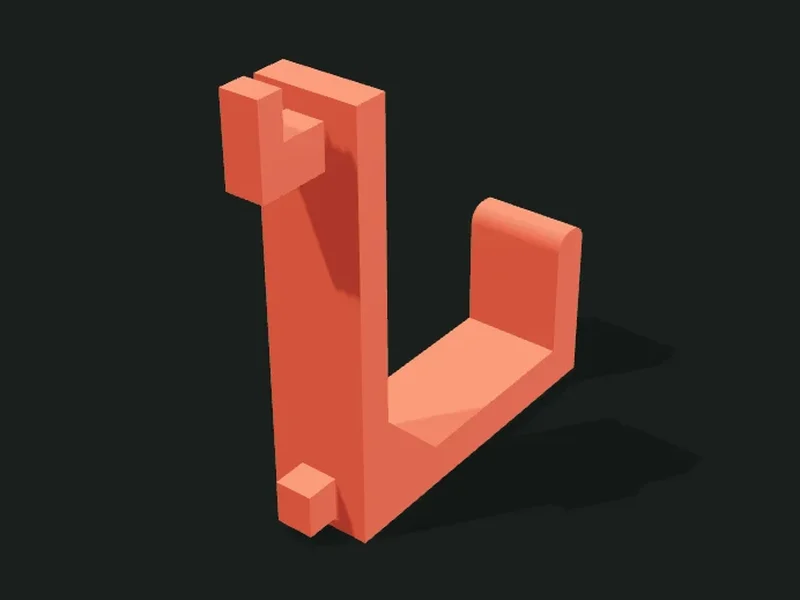
What it’s for
Accessories for pegboards: the IKEA Skådis (vertical slots), the 1-inch American pegboard and the 25 mm metric pegboard. It generates hooks, forks, shelves, small bins, tool holders and roll holders that hook into the board with a latch at the back that keeps them from coming out when pulled. It can also generate the Skådis board itself as tiles to print and join.
Ideas
- Organize tools in the workshop: screwdrivers, pliers, tape measures.
- Desk with Skådis: headphones, cables, pens and chargers.
- Kitchen or laundry: paper rolls, cloths, utensils.
- Craft board with thread, scissors and paints.
Step by step
- In «System» choose your board (Skådis, 1" or 25 mm pegboard) and measure its thickness with calipers.
- Choose a preset or the type of accessory in «Accessory».
- Adjust the width, the forward reach and the height according to what you’ll hang.
- For tool holders, enter the diameter and number of holes; for roll holders, the roll diameter.
- Export and print. If it’s loose or doesn’t go into the board, adjust the clearance.
Tips
- The latch at the back rests right behind the board: if the thickness is measured wrong, the accessory is loose or doesn’t go in.
- Print the hooks on their side (they already come that way on the bed) so they don’t snap at the bend.
- For heavy things, use wide accessories that take two or more holes and raise the thickness.
- Board tiles print up to 220 mm; space them off the wall so the latches fit.
Presets
Parameters
System
Which board you have and the fit into it.
The board it hangs on: IKEA Skådis (5 × 15 mm vertical slots), 1-inch pegboard (1/4" holes every 25.4 mm) or 25 mm metric pegboard (5 mm holes).
Thickness of your board. Measure it with calipers: the latch at the back rests right behind the board. The Skådis is 5 mm.
Play between the hooks and the board’s holes. 0.3 mm fits firmly; raise it if it’s hard to push in.
Accessory
Which accessory is generated and its dimensions.
Which accessory is generated: single hook, fork (two prongs), shelf, small bin, tool holder with holes, roll holder, or the board itself as printable tiles.
Width of the accessory (left to right). It’s adjusted to hook into as many holes as fit.
How far the accessory sticks out forward from the board. Longer holds more things but adds more leverage.
On the hook and the fork, the height of the tip that holds what hangs. On the bin, the height of the walls.
Thickness of the arm of the hook, the shelf or the tool holder. 5 mm is sturdy; for heavy things, 6–8 mm.
Space between the fork’s two prongs. 25–35 mm for headphones; narrower for cables.
Height of the shelf’s front rim, which keeps things from falling. 0 removes it.
Thickness of the bin’s walls. 1.6 mm is enough for screws and small things.
Diameter of the tool holder’s holes. Measure your tools’ handles (a screwdriver goes through 9–10 mm) and add 1 mm.
Total number of holes in the tool holder. They’re spread among the rows and evenly across the width; the app warns you if they don’t fit.
How many rows the holes are spread over, from back to front. The rows are offset a bit so the handles don’t collide.
Maximum diameter of the roll that will hang (tape, paper, film). It sets the length of the arms.
Diameter of the axle the roll goes on. Measure the roll’s hole and subtract 1–2 mm.
Width of the board tile. Up to 220 mm fits most printers.
Height of the board tile. Several tiles are placed side by side to build a big board.
Space behind the board, away from the wall, so the accessories’ latches fit. 8 mm is enough.