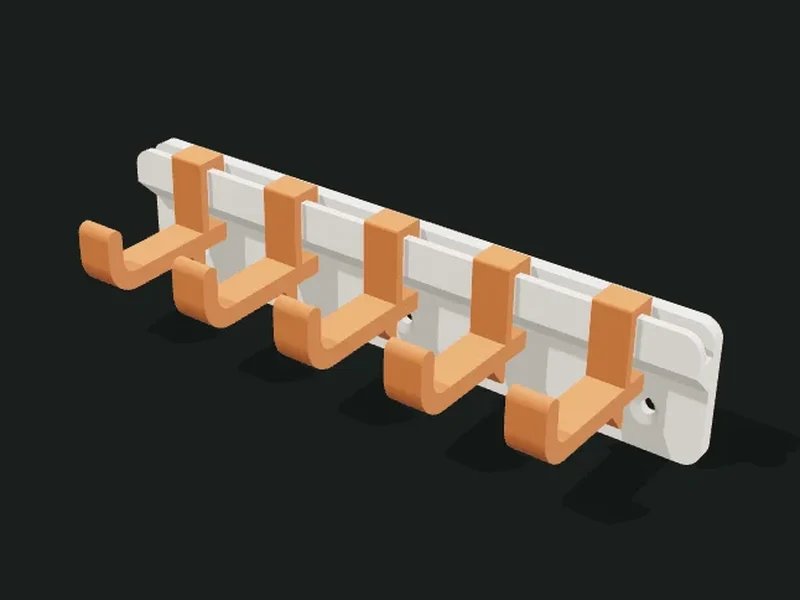
What it’s for
A rail fixed to the wall and hooks that hang from it. The hooks catch in a channel along the rail and can slide to place them wherever you want, or be removed and added without taking the rail down. The hooks print on their side so the layers run along the arm and don’t snap under weight.
Ideas
- Entryway rack to hang keys, jackets and bags.
- Wall key holder with small hooks.
- Rack for backpacks and helmets.
- Headphone or cable holder on the desk.
Step by step
- Choose a preset: «Entryway 5 hooks», «Key holder», «Double rack» or «Headphone pegs».
- In «Rail» set the length, the height and how it’s fixed to the wall.
- In «Hooks» choose how many, the shape (J, double or peg) and the arm size.
- Adjust the clearance so the hooks go into the channel and slide.
- Export. The rail and the hooks come out as separate parts, already laid out for printing.
Tips
- For heavy things (jackets, backpacks), use an arm 8 mm thick or more and screw fixing.
- Double-sided tape works for keys and light things; for more weight, use screws.
- If the hooks are loose in the channel, lower the clearance; if they don’t go in, raise it.
- A rail over 200 mm may not fit your bed: make two shorter rails side by side.
Presets
Parameters
Rail
The plate that goes on the wall, with the channel the hooks catch in.
Length of the rail. The hooks are spread along this length.
Height of the rail plate. Taller leaves room for the screws and spreads the weight better.
Thickness of the rail plate. 4–6 mm is sturdy.
Rounding of the rail’s corners seen from the front.
Depth of the channel, that is, how far down the top lip that holds the hooks goes. Deeper, the hooks sit firmer.
Width of the channel where each hook’s tongue goes. 4–6 mm is sturdy.
Thickness of the lip forming the channel. 3 mm holds weight well.
How the rail is fixed to the wall: holes for countersunk screws (head flush), flat surface for double-sided tape, or no fixing.
Hooks
Number, shape and size of the hooks.
Number of hooks generated. You can print more later and add them to the rail.
Hook shape: classic «J» with the tip pointing up, «Double» with two tips (one higher), or «Peg», straight and slightly tilted with a ball at the tip (for headphones or caps).
Width of each hook (its side dimension). Wider is stronger.
How far the arm sticks out from the wall. 30–40 mm for jackets; 20 mm for keys; 50 mm for backpacks or headphones.
Thickness of the arm. 6 mm holds a jacket; 8 mm or more, a loaded backpack.
Height of the hook’s tip, which keeps what hangs from slipping off. 0 leaves a straight arm.
Radius of the curve between the arm and the tip. A wider curve (8–12 mm) doesn’t mark fabric.
How much the peg tilts upward. 10–15° keeps what hangs from falling off.
Play between the hook’s tongue and the rail’s channel. 0.3 mm slides firmly; with more, they wobble.