
What it’s for
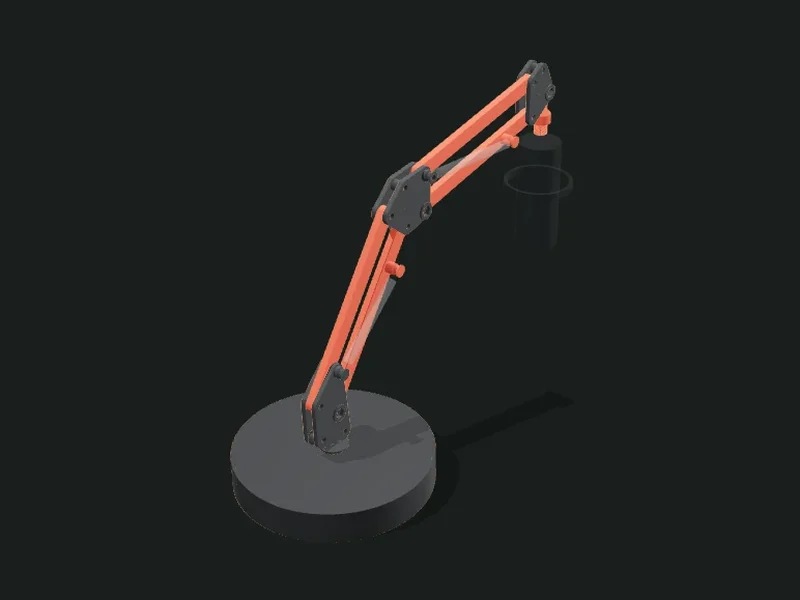
Articulated desk boom arm for a microphone, like the ones used for streaming and podcasts. It has two parallelogram sections (each with two bars), so the elbow and the head keep their angle as you move it, and it rotates 360° on a heavy base or a clamp for the edge of the desk. It is held up by store-bought springs or by friction knobs. The app works out which spring to buy and where to hook it, the range of microphone weights it holds still, the base ballast and the hardware.
Ideas
- Arm for a streaming, podcast or video call microphone.
- Clamp-on arm for a workbench where there is no room for a base.
- Short arm on a base for a light microphone on the desk.
- Friction arm, without springs, for light microphones.
Step by step
- Choose how it stands: heavy base or clamp (and your desk thickness).
- Set the length of each section and the weight of your microphone with its shock mount.
- Choose springs or friction. With springs, let the app work out which one to buy or enter the data of yours.
- Read the notes: the spring to buy, the weight range it holds, the ballast and the hardware.
- Print the parts (plates and bars lying flat, no supports) and buy the bolts and the springs.
- Assemble: bars between the plates, knobs on the left side, springs on the right side, and fill the base with ballast.
Tips
- With the arm stretched out a small base tips over: the app tells you how much ballast it needs and what to fill it with (sand, steel or lead).
- If the arm drifts down, tighten the knobs a little more or add rubber or cork washers between the bar and the plates.
- Extension springs are sold by length, diameter and rate: look for one close to what the app says; if it has initial tension, even better.
- Print plates and bars with 4 walls and 40 % infill: they carry the load.
Presets
Parameters
Mounting
How the arm stands: a heavy base with room for ballast or a clamp on the edge of the desk.
«Heavy base»: a disc that rests on the desk, hollow for ballast. «Clamp»: it grips the edge of the desk with a screw; it holds longer arms without tipping.
Base diameter. The wider it is, the less ballast it needs so the stretched arm does not tip it over.
Base height. Taller means more room for ballast inside.
Makes the base hollow, with ribs and a bottom cover, to fill it with sand, steel shot or washers, or lead.
The thickest desk you want to use it on. The clamp works on any thinner desk.
Horn
The size of both sections, the bars, the plates and the pivot bolts.
Length of the lower section, measured pivot to pivot. Together with the upper one it sets how far the microphone reaches.
Length of the upper section, pivot to pivot. Longer reaches farther but needs stronger springs and more ballast.
Thickness of each bar (what sits between the two plates). It is the height it prints at, lying flat.
Bar width seen from the side. Wider is stiffer and bends less with heavy microphones.
Thickness of the turret, elbow and head plates. 5 mm is sturdy for most microphones.
Size of the pivot bolts. M6 is the usual choice; M8 for long arms or heavy microphones.
Balance
What keeps the arm where you leave it: springs or friction, and the microphone weight.
Weight of the microphone with its shock mount and pop filter. Weigh it on a kitchen scale.
«Springs»: they offset the weight and the arm feels light in any position. «Friction»: no springs, the knobs brake the pivots; good for light microphones.
«Work out which to buy»: the app picks the length, the rate and where to hook it. «I already have a spring»: enter its data and the app finds the best place to hook it.
Outer diameter of the spring. Used to leave room beside the plates.
Length of the spring when relaxed, from inside one hook to inside the other.
How much force it makes for each millimetre you stretch it (N/mm). Hang a known weight: k = kg × 9.81 ÷ millimetres it stretched.
The force needed before the spring starts to stretch (initial tension). If you do not know it, leave 0.
How long your spring can stretch without getting deformed. The app warns you if the arm would overstretch it.
Diameter of the knobs that tighten the pivots. Bigger brakes more with the same hand force.
With rubber or cork washers between the bar and the plates, the knobs brake more than twice as much as plastic on plastic.
Head
The thread the shock mount or microphone screws onto.
The male thread on the head. 5/8″ fits almost every stand and shock mount; 3/8″ is used on European gear.
Preview position
How the arm looks on screen. It does not change the parts.
Tilt of the lower section in the preview, from vertical. Only to see how it looks: the parts do not change.
Tilt of the upper section in the preview, from vertical (90° is horizontal). Only to see how it looks.