What it’s for
Curtain rods, towel bars and roll holders of any length: the rod is split into equal sections that print standing up on your printer and join with a thread or a press fit. It includes the finials (decorative ends), the wall, ceiling or wall-to-wall brackets, the rings that slide along the rod and a holder for toilet paper or kitchen rolls.
Ideas
- Curtain rod from 1 to 3 m with open brackets, to remove the curtain by lifting it.
- Double rod for curtain and sheer on the same bracket.
- Towel bar between two walls or inside a window frame, with cups.
- Toilet paper or kitchen roll holder screwed to the wall.
Step by step
- Choose the rod diameter (19 or 25 mm are the most common) and use the same one in all parts.
- In «Rod sections» enter the total length and your printer’s maximum height: it tells you how many sections to print.
- Print the finials (one male and one female) and the brackets: one at each end and one every 1 to 1.2 m.
- If it’s for a curtain, print the rings and put them on before screwing on the last finial.
- Screw the brackets to the wall, screw the sections together by hand until they stop and rest the rod on them.
Tips
- Print the sections in PETG if you can: the joints are what works hardest. In PLA, with 3 perimeters.
- If the thread is stiff, raise the «Joint clearance» in 0.05 mm steps; if it’s loose, lower it.
- For a custom finial choose «Custom silhouette», start from one of the editor’s silhouettes and modify it: the joint is added automatically.
- For a nicer bracket try the «Arm shape» options: the plate, the screws and the ring adjust to each one automatically.
- Measure the distance from the wall to the center of the rod: it must clear the frame, the blind or the heater.
- For long rods, add a middle bracket: without it, the rod sags under the curtain’s weight.
Presets
Parameters
Part
Which part is generated and the rod diameter, which must be the same in all of them.
Which part to print: the rod sections, the end finials, a bracket, the curtain rings or the roll holder.
Diameter of the rod. Use the same one for sections, finials, brackets and rings: everything is calculated from this value.
Rod
Length, number of sections and how they join.
Total length of the rod, not counting the finials. It’s split into equal sections that fit your printer.
Maximum height your printer can print. The sections (and the roll holder’s axle) are cut so they don’t exceed it.
How the sections join: thread (screwed together by hand and easy to take apart) or press fit (simpler to print; best locked with the set screw).
Adds a hole for an M3 screw that goes through the press fit and locks it, so the rod doesn’t come apart when pulling the curtain.
Leaves the section hollow inside to save plastic and time. With a 3 mm wall it’s still sturdy; turn it off for rods carrying a lot of weight.
Wall thickness of the hollow section. 2.4 to 3 mm is enough for curtains and towels.
Play between the male and female of the joint. 0.3 mm works on most printers; if it’s stiff, raise it.
End caps
Shape and size of the decorative ends.
Shape of the finials: ball, point, disc, cube, a simple cap as wide as the rod, or a custom silhouette you draw in the editor.
The finial’s half silhouette, drawn in the editor with points and curves: the first point goes on the rod’s side and the last one is the tip. It scales to the «Size» automatically; if any segment exceeds 45°, the app warns you because it would need supports.
Largest diameter of the finial’s head. Between 1.5 and 2 times the rod diameter looks proportionate.
Stand
Type of bracket, distance from the wall and screws.
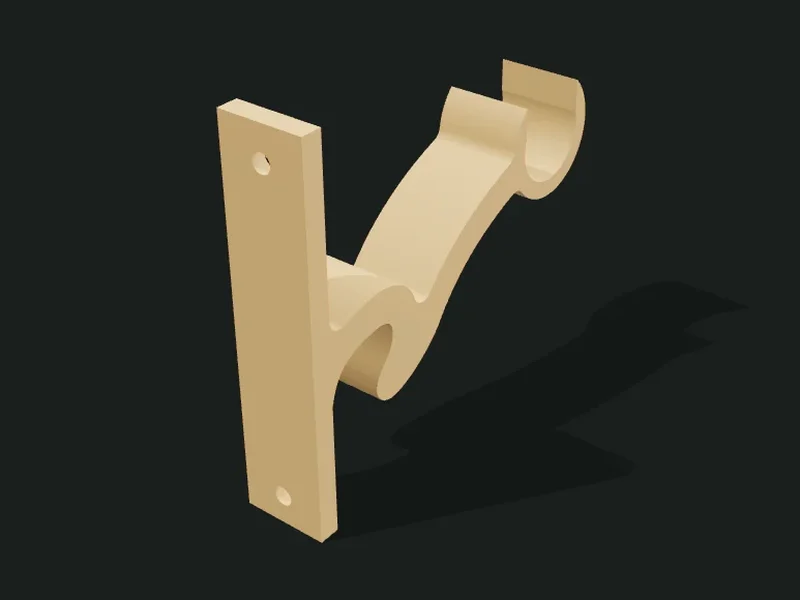
Type of bracket: open wall bracket (the rod rests on it and lifts out), closed wall bracket (the rod goes through a ring), double (curtain and sheer), ceiling, or cup for a rod between two walls or inside the frame.
Distance from the center of the rod to the wall (or ceiling). It must clear the frame, the blind or the heater.
On the double bracket, distance between the inner rod (sheer) and the outer one (curtain).
Cup open on top: the rod rests on it and lifts out, like a towel bar. Closed: the rod is enclosed between the two cups.
Shape of the wall bracket’s arm: straight with a 45° gusset (the classic, the strongest) or one of the decorative shapes (swan neck, arch, wave, scroll, lyre, square, hook and more). They all grow or shrink with the «Distance from the wall» and let you lift the rod out.
Stroke thickness of the decorative arms. 8 to 10 mm is enough for curtains; for big distances or heavy curtains, raise it together with the bracket width.
Width of the bracket. 20 mm is enough for light curtains; raise it to 25–30 mm for heavy curtains or big distances.
Diameter of the screws that fix the bracket or the roll holder to the wall. The holes are countersunk so the head sits flush.
Rings
Rings that slide along the rod and hold the curtain.
Clearance between the ring and the rod. With more clearance they slide better and pass the joints without catching.
How many rings you need: normally one every 10 to 15 cm of curtain. It’s only used for the note on how many to print.
Roll holder
Dimensions of the paper roll.
Width of the paper roll. Toilet paper is around 100–115 mm; kitchen paper, 220–280 mm (then the holder comes in two brackets).
Maximum diameter of a new roll. It sets how far the axle stands off the wall so the roll turns without rubbing.