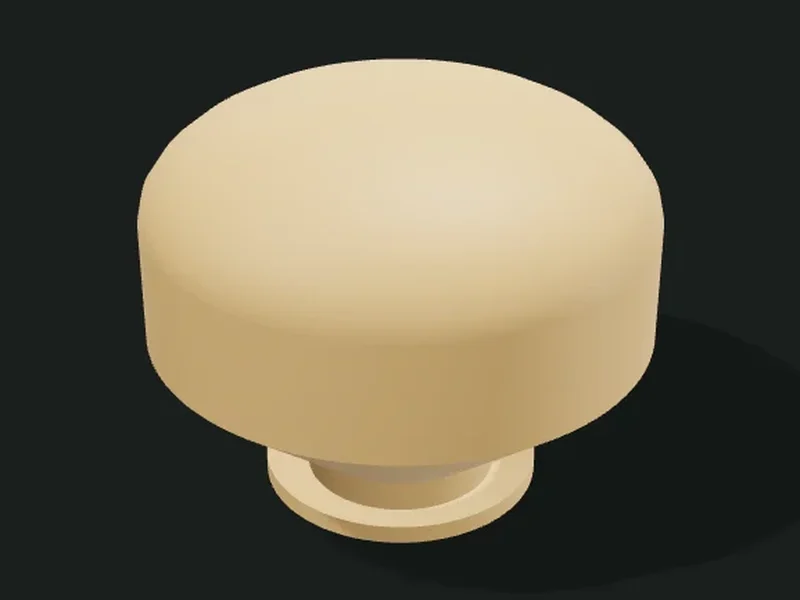
What it’s for
Small hardware for furniture and the home: knobs and pulls for drawers and doors, with the standard hole spacing to replace the ones you already have; leg caps that protect the feet of chairs and tables; wedges to hold doors open and corner guards to cover sharp corners. Knobs and pulls are fixed with a heat-set threaded insert, an embedded nut or a self-tapping screw.
Ideas
- Renew the knobs or pulls of a dresser, a closet or a kitchen.
- Replace worn chair leg caps that scratch the floor.
- Wedge with text so the door doesn’t slam shut in the wind.
- Protective corner guards for a coffee table, with kids in mind.
Step by step
- Choose a preset or the type of part in «Part».
- For knobs: choose shape, diameter, height, facets or grooves and an engraved letter if you want.
- For pulls: measure the distance between your furniture’s holes and choose it in «Hole spacing».
- For leg caps and corner guards: measure the leg or the board with calipers.
- In «Fastening» choose the screw and the method, and export.
Tips
- Pull hole spacings are standard (multiples of 32 mm): measure center to center.
- The heat-set threaded insert is the firmest: it’s set with the soldering iron and withstands pulling for years.
- Print leg caps in TPU (flexible) if you want them to stay put and be quiet; in PLA, with felt underneath.
- Furniture screws are usually M4; if your old pulls use another, take one to the hardware store.
Presets
Parameters
Part
Which hardware is generated.
Which hardware: knob (gripped with the fingers, one screw), pull (handle with two screws), leg cap (cap for the tip of a leg), door wedge or protective corner guard.
Knob
Shape and size of the knob, and the grip.
Knob shape: mushroom (wide head on a narrow neck, the classic), cylinder, inverted cone (wider on top) or disc (flat and wide).
Diameter of the knob. 25–35 mm is the usual size for drawers.
Height of the knob, how far it sticks out from the furniture. 20–30 mm lets you grip it comfortably.
Number of side faces: 0 leaves it round; 5 to 12 makes it faceted (hexagonal, octagonal…).
Number of grooves on the side for a better grip. 0 leaves it smooth.
A letter, a number or a short emoji engraved on top of the knob. Leave it empty if you don’t want one.
Pull
Hole spacing, shape and size of the pull.
Distance between the centers of the pull’s two holes. Measure it on your furniture: the values are standard (32, 64, 96, 128, 160 or 192 mm).
Pull shape: straight bar on two legs, curved arch, or flat with rounded ends.
How far the pull extends beyond each hole. 0 ends right at the screws; 10–20 mm gives a longer, more elegant pull.
Space between the furniture and the bar, where the fingers go. 22–28 mm is comfortable.
Width of the pull’s bar (seen from the front). 10–14 mm is comfortable to grip.
Thickness of the pull’s bar. 8 mm or more is sturdy for pulling a heavy drawer.
Foot cap
Dimensions of the leg the cap goes on.
Shape of the leg the cap goes on: round, or square / rectangular.
Diameter of the round leg, or width of the square leg. Measure it at the tip with calipers.
Depth of the square or rectangular leg (the other side).
How far the cap goes up the leg. 12–15 mm holds it firmly.
Leaves a recess under the cap to glue a felt pad, which protects the floor and lets the chair slide quietly.
Wedge and corner
Dimensions of the door wedge and the corner guard.
Space between the door and the floor. The wedge is calculated to fit in that gap and hold the door.
Text engraved on the wedge (for example «STOP»). Leave it empty if you don’t want any.
Thickness of the table or furniture board the corner guard goes on. Measure it with calipers.
Radius of the corner guard’s curve, which rounds off the sharp corner. Bigger protects better.
Mounting
How knobs and pulls are screwed on, or the fit of leg caps and corner guards.
Size of the screw that fixes the knob or pull. M4 is the furniture standard.
How the screw grips: brass threaded insert set with heat (the firmest), nut embedded in a hexagonal pocket, or self-tapping (cuts the thread in the plastic; the simplest).
Play between the leg cap or corner guard and the leg or board. 0.2–0.3 mm is a press fit.