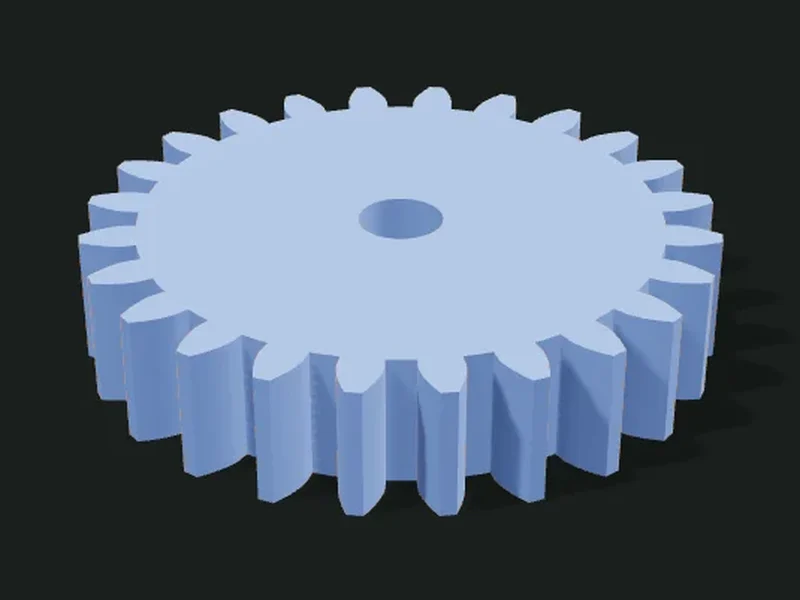
What it’s for
Gears with an involute profile (the mechanical standard): spur, helical or herringbone, plus racks and pulleys for GT2 belts. They have backlash between teeth so they turn well when printed, a shaft hole (round, D-shaped for motors or hexagonal) and an optional hub with a set screw. It can show the mating gear meshed at the right center distance.
Ideas
- Repair a toy, an appliance or a blind with a broken gear.
- Reducers for stepper motors or servos in robotics projects.
- GT2 pulleys for 3D printers, CNC machines or motorized cameras.
- Teaching material and display mechanisms.
Step by step
- Choose a preset: spur, reduction pair, helical, herringbone, rack or GT2 pulley.
- In «Type» choose the kind of gear, the module (tooth size) and the number of teeth.
- If it will mesh with another, turn on «Show the meshing gear» and enter its teeth: the app shows the center distance.
- In «Shaft and hub» choose the shaft hole and, if needed, the hub with set screw.
- Adjust the backlash and export.
Tips
- Two gears only mesh if they have the same module and the same pressure angle.
- The reduction ratio is the big gear’s teeth ÷ the small one’s: 36 and 12 give 3:1.
- Helical and herringbone gears are quieter and smoother; herringbone doesn’t push sideways.
- To copy a broken gear: count the teeth and measure the outer diameter; module ≈ outer diameter ÷ (teeth + 2).
- Print working gears in PETG or nylon; PLA wears quickly with friction.
Presets
Parameters
Type
What kind of gear it is and the shape of its teeth.
Type: spur (teeth parallel to the shaft, the simplest), helical (slanted teeth, quieter), herringbone (double helical in a V, quiet and without side thrust), rack (straight toothed bar) or GT2 pulley (for a toothed belt).
Tooth size, in millimeters: the pitch diameter is module × teeth. 1–1.5 is small and precise; 2–3 is robust. Two gears only mesh if they have the same module.
Number of teeth. With fewer than 12–13 the teeth are undercut and weak.
Tooth pressure angle. 20° is today’s standard; 14.5° is used in old gears; 25° gives stronger teeth. It must be the same on both meshing gears.
Tilt angle of the helical teeth. 15–25° is smooth and quiet; more tilt pushes more sideways.
Thickness of the gear (face width). Thicker takes more force.
Play between the teeth of two gears, so they turn without jamming when printed. 0.15–0.25 mm is usual.
Pair
The mating gear or the rack it meshes with.
Shows the gear (or pinion) that meshes with this one, at the right center distance, and exports it too.
Number of teeth of the mating gear. The reduction ratio is the division between the two.
Length of the rack. Each turn of the pinion moves it π × module × pinion teeth.
Height of the material under the rack’s teeth. Taller is stiffer.
Pulley
Toothed pulley for a GT2 belt.
Number of teeth of the GT2 pulley. 16 and 20 are the most common in 3D printers.
Width of the GT2 belt (6 mm is the common one; 9 or 10 mm for more force). The pulley has flanges on each side.
Shaft and hub
How it mounts on the shaft and how it’s fixed.
Shape of the shaft hole: round, with a flat (like the D shaft of stepper motors), hexagonal (for a nut or a hex shaft) or no hole.
Shaft diameter (or across flats if hexagonal). NEMA 17 motors have a 5 mm shaft. Add 0.1–0.2 mm if it’s tight.
Adds a hub: a cylinder sticking out around the shaft that gives more gripping surface and room for the set screw.
Diameter of the hub. It must leave at least 4 mm of wall around the shaft for the set screw.
Height of the hub (how far it sticks out from the gear). 7–8 mm leaves room for the M3 set screw.
Adds a radial hole for an M3 set screw and the pocket for its nut, to fix the gear to the shaft.
Makes holes in the gear’s body to save material and time, without touching the teeth or the hub.