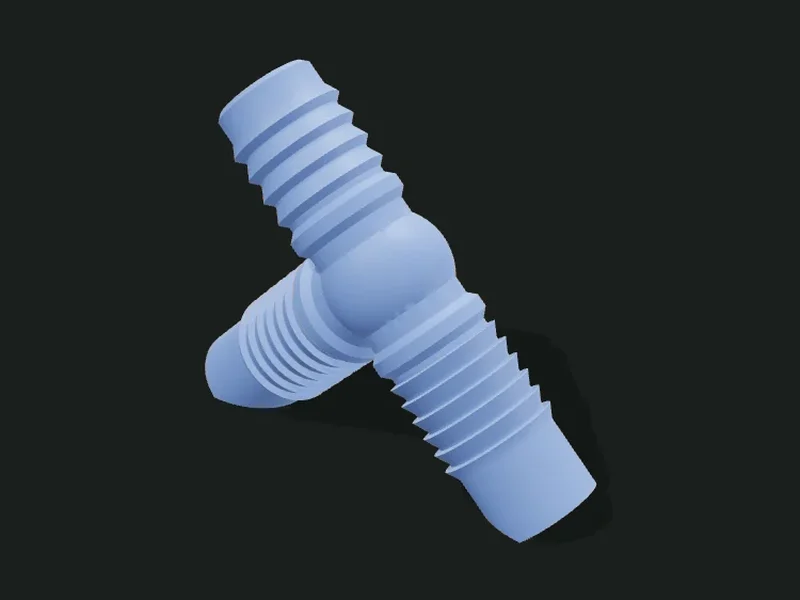
What it’s for
Parts to join hoses, pipes and rods. Hose connectors that go inside (straight union, reducer, elbow, T, Y, cross, manifold and plug), with grip rings and a stop collar. Adapters between two different sizes or systems (spigot, socket or BSP faucet thread). Hose clamps and nodes to build structures with rods or pipes (corners, T, crosses).
Ideas
- Drip irrigation: T, elbows, manifolds and plugs for 16 mm hose.
- Connect the hose to the faucet (3/4" thread).
- Adapt the vacuum cleaner to a tool with a different port.
- Build shelves, greenhouses or frames with pipes or rods and printed corners.
- Aquariums: T and Y for 4 mm air tubing.
Step by step
- Choose a similar preset or the type in «Part».
- Measure: for a hose, the inside diameter (the spigot goes into it); for a pipe that goes into the part, the outside one.
- For connectors, choose the shape and the diameters of each outlet.
- For adapters, set up each end: spigot, socket or thread, with its size.
- Adjust wall and clearance in «Walls and fit» and export.
Tips
- For parts with pressurized water, print in PETG with 3 or more perimeters and 100 % infill on the spigots.
- The spigots match the hose’s inside diameter: the grip rings make the seal. With a clamp, it won’t come off.
- BSP threads are the faucet threads used in Argentina and Europe; GHT is the US garden hose thread.
- With small hoses (4 mm) lower the wall to 0.8 mm so the spigot isn’t thicker than the hose.
Presets
Parameters
Part
What type of part is generated.
Type of part: hose connector (joins hoses by going inside them), adapter (joins two different sizes or systems: spigot, socket or thread), clamp (squeezes the hose) or node for rods or pipes.
Hose connector
Connector that goes inside the hoses: shape, diameters and spigots.
Connector shape: straight union (or reducer if the diameters differ), elbow, T, Y, cross, manifold (one inlet and several outlets) or plug (closes the end of a hose).
Inside diameter of the main hose. It’s the diameter of the spigot that goes into it. Measure it with calipers (16 mm irrigation hose is about 13.6 mm inside).
Inside diameter of the branch hose or the other end. If it differs from the main one, the connector acts as a reducer.
Angle of the elbow. 90° is the L elbow; 45° a gentle bend.
Opening between the two arms of the Y. Up to 90°: wider, one arm would lie too flat and need supports.
Number of manifold outlets, spread in a row along the part.
Length of each spigot, what goes into the hose. Longer grips more; 15–25 mm is usual.
Adds sawtooth rings on the spigots that bite the hose from inside so it doesn’t come off.
Adds a stop at the base of each spigot, where the hose ends. It looks neat and supports the clamp.
Bottom end
How the adapter’s first end fits.
How the bottom end fits: spigot (goes into a hose; measure its inside diameter), socket (the pipe goes into the part; measure its outside diameter), male thread or female thread.
Diameter of the bottom end: the hose’s inside diameter if it’s a spigot, or the pipe’s outside diameter if it’s a socket.
Thread of the bottom end. BSP 3/4" is the common faucet thread; 1/2" the under-sink one; GHT is the US garden hose thread.
Length of the bottom end (spigot, socket or thread). For threads, 12–16 mm takes several turns.
Top end
How the adapter’s second end fits, and whether it bends.
How the top end fits: spigot, socket, male thread or female thread (same as the bottom one).
Diameter of the top end: the hose’s inside diameter if it’s a spigot, or the pipe’s outside diameter if it’s a socket.
Thread of the top end. BSP 3/4" is the common faucet thread.
Length of the top end (spigot, socket or thread). For spigots, 20–30 mm grips well.
Tilts the top end relative to the bottom one, up to 45° (more would need supports). For a bigger angle use «Hose connector → Elbow».
Clamp
Clamp that squeezes the hose onto the spigot.
Outside diameter of the hose the clamp will squeeze (with the spigot inside).
Width of the clamp. 8 mm squeezes well; wider spreads the pressure better.
Rod connector
Node to join rods or pipes and build structures.
Node shape: L (2 arms at 90°), T (3 in a plane), cross (4 in a plane), 3D corner (3 arms on the three axes, for cubes), T with leg (4 arms), five arms or straight union.
Type of rod that goes into the node: round (or pipe) or square.
Diameter of the round rod, or side of the square one. Measure it with calipers.
Depth of each socket, how far the rod goes in. Deeper is firmer; 1 to 1.5 times the diameter is usual.
Adds a hole for an M3 screw that goes through each arm and locks the rod.
Walls and fit
Wall thickness and play for sockets, threads and rods.
Wall thickness of the part. In hose connectors, thinner lets more water through; in nodes and adapters, 2–2.4 mm is sturdy.
Play for sockets, threads and rods. 0.3 mm fits firmly. Spigots don’t use it: they match the hose diameter.