What it’s for
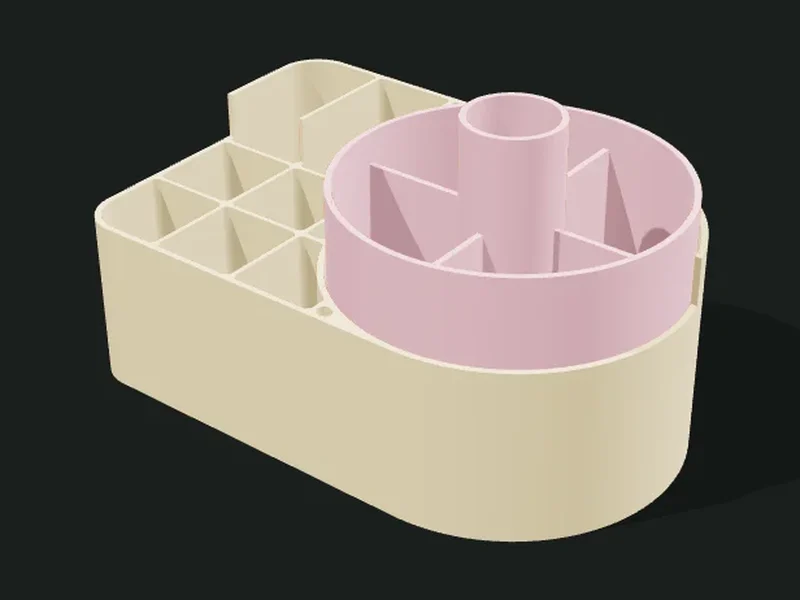
A round cup that spins on a pin, divided into sectors by radial dividers and with a tall tube in the center. It can be printed on its own, on a turntable base, or fitted at the end of a box with a grid of compartments, like cosmetics organizers.
Ideas
- Rotating makeup organizer: brushes in the tube, lipsticks in the sectors.
- Carousel for brushes and colored pencils for drawing.
- Rotating spice or sauce holder.
- Organizer for small tools in the workshop.
Step by step
- Choose a preset: «Cosmetics holder» (with box), «Brush carousel» or «Turntable of 3».
- In «Carousel» adjust diameter, height, how many radial dividers and the central tube.
- In «Stand» choose whether it goes in a grid box, on a turntable base or with no stand.
- If you choose a box, adjust the grid width, its columns and rows and the height of the box and back.
- Check the «Exploded» view to see the carousel separated from the stand and export.
Tips
- The pin clearance sets how it spins: 0.6–0.8 mm spins smoothly; with less it may jam.
- An 8–10 mm pin is sturdy; thinner may snap if you load the carousel heavily.
- If the box is over 220 mm, the app warns you: lower the grid width or the diameter.
- A drop of petroleum jelly or graphite on the pin makes it spin much more smoothly.
Presets
Parameters
Carousel
The spinning cup: size, sectors and central tube.
Outer diameter of the carousel. 90–120 mm is a comfortable desk size.
Height of the carousel’s outer rim. For cosmetics, 70–90 mm; for brushes, taller.
Number of dividers running from the center to the rim, like slices of cake. 0 leaves it undivided.
How much lower than the rim the radial dividers are. About 10–30 mm lets you reach in.
Diameter of the center tube, which stands taller than the rest (ideal for brushes or pens). 0 removes it.
Height of the central tube. It’s usually taller than the rim so the brushes are at hand.
Thickness of the carousel’s walls. 1.6–2 mm is sturdy.
Thickness of the carousel’s floor. 2 mm is enough.
Stand
What the carousel spins on: a box with compartments, a simple base or nothing.
«Grid box» adds a box with compartments and the carousel spins at one end. «Turntable base» is a simple plate with the pin. «No stand» leaves just the cup.
Diameter of the pin the carousel spins on. 8–10 mm is sturdy.
Play between the pin and the carousel’s hole, and between the carousel and the box. 0.6–0.8 mm spins smoothly without wobbling.
Length of the grid part of the box (not counting the recess where the carousel goes).
Height of the front of the grid box. It should be lower than the carousel so the carousel shows.
Height of the box’s back wall. If it’s higher than the front, the rim slopes toward you.
Columns of the box’s grid and their relative width. «1,1,1,1» is four equal ones.
Rows of the grid (front to back) and their relative depth.
Rounding of the box’s corners seen from above.
Outer texture
Decorative relief on the outer walls. It doesn’t change the inside sizes.
Relief on the outer walls. The texture is added outward: the inside and the wall thickness don’t change, so inserts and usable sizes stay the same. «Ribs» and «Flutes» are vertical, «Rings» horizontal, «Waves» helical and «Knurl» a diamond pattern that gives grip.
How far the texture sticks out (mm). 0.6–1 mm shows well without overdoing it; more than 2 mm adds a lot of material and print time.
Spacing between ribs, flutes or waves measured around the part. Small values give fine striping; large ones, bold. It should be at least 3 times the relief.
Vertical spacing between rings, waves or knurl diamonds. With 0.2 mm layers, less than 2 mm looks stepped.