What it’s for
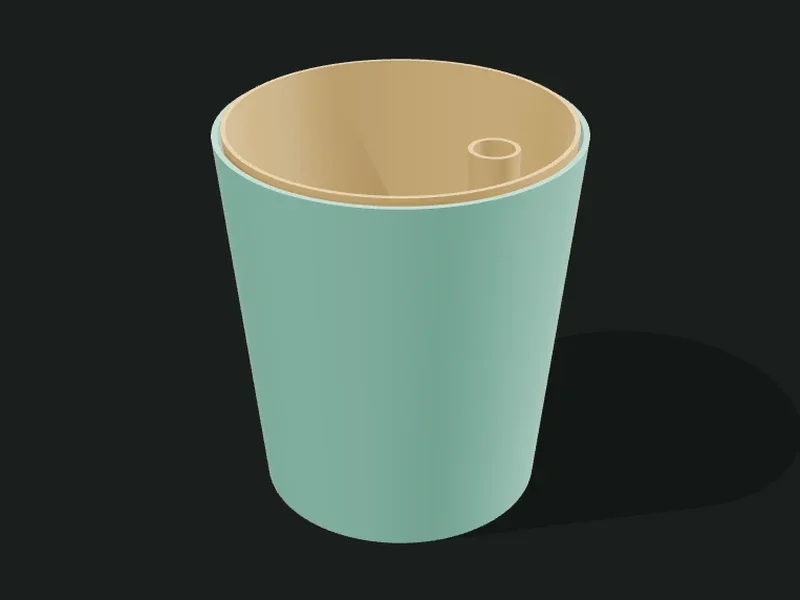
A planter that waters itself. It has two parts: an outer reservoir that holds water and an inner pot with a funnel bottom ending in a wick cup. The cup goes down into the water, the soil inside absorbs it and the plant takes what it needs for days. It has a tube to add water without removing the pot and an overflow so the roots don’t drown. The reservoir is designed with section, twist and surface effects, just like the planters.
Ideas
- Indoor plants for people who forget to water or go on trips.
- Herbs in the kitchen (basil, parsley, mint).
- Small desk planter for a pothos or a succulent.
- Gift with a plant included.
Step by step
- Choose a preset: plain, twisted hexagonal, fluted, small desk or large honeycomb.
- In «Reservoir shape» adjust the base and rim radii, the height, the section and the twist.
- Add surface effects if you want: they go only on the outside, the inside stays smooth and watertight.
- In «Watering» choose the water depth, the wick cup size, the filling tube and the overflow.
- Check thicknesses and clearance in «Walls» and export: reservoir and inner pot come out separately.
Tips
- So the reservoir doesn’t leak, print with 3 or more perimeters, or in thick-wall mode; PETG seals better.
- Fill the wick cup with well-packed soil: it’s what carries the water from the bottom up.
- For the first few days also water from above until the roots grow down.
- The overflow keeps you from overfilling: if water comes out there, the reservoir is full.
Presets
Parameters
Reservoir shape
The shape of the outer part, which is the one you see.
Radius of the reservoir at the base (half the bottom width).
Radius of the reservoir at the rim, on top. Bigger than the base gives an open planter.
Total height of the reservoir. The inner pot is calculated to fit in the opening.
Shape of the reservoir seen from above: round, polygon, star, flower or rounded square. The inner pot stays round.
Number of sides of the polygon or points of the star or flower.
How pronounced the points of the star or the petals of the flower are.
How many degrees the section rotates from the base to the rim. It gives a swirl effect on polygon or flower sections.
Surface effects
Decorative relief on the outside of the reservoir.
Surface effects (flutes, honeycomb, waves and more) only on the outside of the reservoir: the inside stays smooth and watertight. See the «Surface effects» page.
How fine the surface mesh is. Design in «Normal» and switch to «High» before exporting.
Watering
How much water it holds and how it reaches the soil.
Depth of the water in the reservoir, which is also the height of the wick cup: the water reaches where the funnel starts. More depth, more days of autonomy.
Radius of the wick cup, the cylinder that goes down from the pot’s bottom into the water. Wider carries more water to the soil.
Adds a tube on the side of the inner pot to fill the reservoir without removing the plant.
Diameter of the filling tube. 12–14 mm fits the spout of a watering can or a bottle.
Hole in the reservoir at the maximum water level: if you overfill, it comes out there and the roots don’t drown.
Walls
Thicknesses of both parts and the play between them.
Thickness of the reservoir’s wall. 2 mm or more, with several perimeters, so it doesn’t leak.
Thickness of the reservoir’s bottom. 2.4 mm or more so it stays watertight.
Thickness of the inner pot’s wall. Since it doesn’t hold water, it can be thinner (1.6 mm).
Play between the inner pot and the reservoir’s opening. 1–1.5 mm goes in and out easily even with soil.